Kodak Six-20 Brownie
Specification
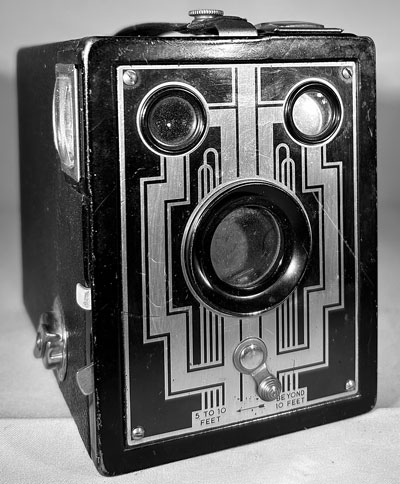
US Model
| Manufacturer | : | Kodak - US |
|---|---|---|
| Produced | : | 1933 - 1941 |
| Classification | : | Medium Format |
| Body Type | : | Box |
| Construction | : | Cardboard/Metal |
| Film Type | : | 620 |
| Film Width | : | 62mm |
| Image Size | : | 2¼ x 3¼ in |
| No. of Images | : | 8 |
| Lens Type | : | Meniscus |
| Focus Type | : | Fixed + Portrait setting |
| Focal Length | : | 90mm |
| Focus Range | : | 5ft to inf |
| Aperture Type | : | Multihole |
| Aperture | : | f/16, f/22 |
| Shutter Type | : | Rotary (flip-flop) |
| Shutter Speeds | : | B,I*(1/40 sec) |
| Size (w x h x d) | : | 83 x 110 x 130 mm |
| Weight | : | 451g |
| * Measured on this camera | ||
Art Deco Credentials

Iconic: Famous, well-known and celebrated
- Produced after the main Art Deco period;
- Geometric Art Deco front panel;
- Chrome finder surrounds
- Chrome winder, and strap posts;
- Symmetrical face.
Description
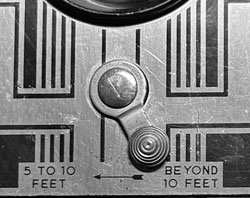
The Kodak Six-20 Brownie is a box-type camera from the 1930s. The facade has a strong symmetrical geometric pattern. The body is cardboard and covered in leatherette. The internal parts are metal. It has two brilliant reflecting finders for both portaits and landscapes. It has a Diway lens meaning that it can do close-ups. There is a lever below the lens that retracts the front lens to take close-up portraits. This reduces the focussing distance to between 5ft and 10ft.
The shutter is of the flip-flop type. Press the shutter lever down to take one photo, press it back up again to take the next. There is a sliding tab on the side above the shutter lever providing the 'bulb' function. A sliding tab on the top allows the aperture to be changed. Tab down f/16, tab up f/22.
How to Use
This camera takes 620 film which is still available from selected photographic outlets. Although the actual film is the same as 120 film, the spools are different. The 620 spools are slightly shorter and have a smaller diameter. Do not use 120 film in this camera because it will jam and may snap. It is possible to cut down a spool of 120 film to fit or to re-spool some 120 film onto 620 spools in a darkroom or changing bag.
Don't forget to ask for your 620 spool back when getting the film developed.
As the shutter speed is only 1/40s, it is advisable to hold it against a wall or other solid object to get shake free shots. There are no tripod sockets. For quick snapshots, hold it firmly against your body.
If you don't want to bother with an exposure meter, follow the guide shown. It is based on the 'Sunny 16' rule. Film is so forgiving and will produce acceptable results even when overexposed by 2 or 3 stops or underexposed by 1 stop.
The tables assume that the sun is at least 30 degrees above the horizon - that's 10am - 5pm on a summers day in the UK.
Remember that the exposure guide in the manual may not be helpful as it is based on the use of old film with a low ISO value.
The camera has 2 aperture values available controled by a metal tab. Aperture values are:- f/16 (Tab Down); f/22 (Tab Up). If you are not sure about the light level, err on the side of overexposure - i.e. assume the lower light level.
Using ISO 100 film - shutter speed 1/40s
| Weather Conditions | Shadow Detail | Aperture | Exposure |
|---|---|---|---|
 Sunny SunnySnow/Sand | Dark with sharp edges | Tab Up f/22 | +1 Stop Overexposed Acceptable |
| Sunny | Distinct | Tab Up f/22 | Good |
 Slight Overcast Slight Overcast | Soft around edges | Tab Down f/16 | Good |
 Overcast Overcast | Barely visible | Tab Down f/16 | -1 Stop Underexposed Acceptable |
 Heavy Overcast Heavy Overcast | None | Tab Down f/16 | -2 Stops Underexposed Not Acceptable |
 Open Shade Open Shade/Sunset | None | Tab Down f/16 | -3 Stops Underexposed Not Acceptable |