Ernemann Film K
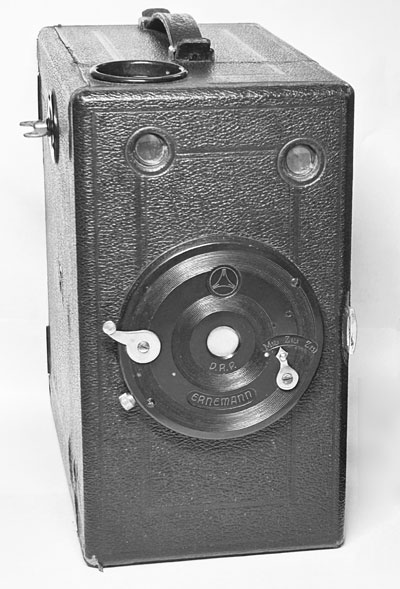
Art Deco Credentials ⓘ

Geometric styling first enters camera design


Limited: Minor and largely incidental Deco elements
- Produced before the main Art Deco period.
- Embossed square rectangles on all sides in the leather covering.
- Bakelite front plate.
- Chrome shutter and aperture controls.
- Multiple Concentric engravings on front plate..
- Leather handle
Specification
| Manufacturer | : | Ernemann |
|---|---|---|
| Produced | : | 1917 - 1926 |
| Classification | : | Medium Format |
| Body Type | : | Box |
| Construction | : | Wood/Metal/Bakelite |
| Film Type | : | 116 |
| Film Width | : | 70mm |
| Image Size | : | 2½ x 4¼ in |
| No. of Images | : | 8 |
| Lens Type | : | Meniscus |
| Focus Type | : | Fixed |
| Focal Length | : | 120mm |
| Focus Range | : | 10m to inf. |
| Aperture Type | : | Multihole |
| Aperture | : | f/12.5, f/25 |
| Shutter Type | : | Rotary |
| Shutter Speeds | : | Z(B),M(I)*(1/20 sec) |
| Size (w x h x d) | : | 90 x 160 x 155 mm |
| Weight | : | 599g |
| * Measured on this camera | ||
Description
The Ernemann Film K comes in a variety of sizes which all look the same. The image sizes available are 6x6cm, 6x9cm, 6.5x11cm and 7.25x12.5cm. The one shown here is the 6.5x11cm version.
The film is loaded by opening the hinged side of the camera. It has two reflecting ground glass viewfinders, one for portraits and one for landscape. It has two tripod mounts, one for each orientation.
The aperture and shutter settings are linked. These are changed by a lever on the front. The options are:-- Momentary (M) - Instant shutter with and aperture of f/12.5.
- Bulb setting (Z 12.5) - Aperture setting f/12.5.
- Bulb setting (Z 25) - Aperture setting f/25.
It has a very slow shutter speed of around 1/20 of a second. There is a connection for a remote cable which would help with reducing camera shake.
How to Use
This Ernemann Film K uses 116 film which is not available anymore except as expired films. This means that the camera needs modification to take 120 film. Modification is fairly straight forward and will easily give 5 'panoramic' exposures producing 2¼ x 4¼ inch negatives. Check out my page on 'Conversion of a 116 camera to take 120 film'.
When this camera is used in Instant mode, the aperture settings is 1/12.5. With a shutter speed of only 1/20 sec, make sure you use a tripod or brace the camera against your body or something solid. Press the shutter smoothly or use a remote cable attachment to avoid camera shake.
If you don't want to bother with an exposure meter, follow the guide below. It is based on the 'Sunny 16' rule. Film is so forgiving and will produce acceptable results even when over-exposed by 2 or 3 stops or under-exposed by 1 stop.
The tables also assume that the sun is at least 30 degrees above the horizon - that's 10am - 5pm on a summers day (May - August) in the UK.
I advise using ISO 50 film but I show performance for both ISO 50 and ISO 100 below.
Using ISO 50 Film - Shutter Speed 1/20s
| Weather Conditions | Shadow Detail | Aperture | Exposure |
|---|---|---|---|
 Sunny SunnySnow/Sand | Dark with sharp edges | Tab Up f/20.5 | +2 Stops Overexposed Acceptable |
| Sunny | Distinct | Tab up f/20.5 | +1 Stop Overexposed Acceptable |
 Slight Overcast Slight Overcast | Soft around edges | Tab up f/20.5 | Good |
 Overcast Overcast | Barely visible | Tab Middle f/20.5 | -1 Stop Underexposed Acceptable |
 Heavy Overcast Heavy Overcast | None | Tab Down f/20.5 | -2 Stops Underexposed Not Acceptable |
 Open Shade Open Shade/Sunset | None | Tab Down f/20.5 | -3 Stops Underexposed Not Acceptable |
Using ISO 100 Film - Shutter Speed 1/20s
| Weather Conditions | Shadow Detail | Aperture | Exposure |
|---|---|---|---|
| Sunny Snow/Sand | Dark with sharp edges | Tab Up f/20.5 | +3 Stops Overexposed Acceptable |
| Sunny | Distinct | Tab up f/20.5 | +2 Stops Overexposed Acceptable |
| Slight Overcast | Soft around edges | Tab up f/20.5 | +1 Stop Overexposed Acceptable |
| Overcast | Barely visible | Tab Middle f/20.5 | Good |
| Heavy Overcast | None | Tab Down f/20.5 | -1 Stops Underexposed Acceptable |
| Open Shade /Sunset | None | Tab Down f/20.5 | -2 Stops Underexposed Not Acceptable |