Certo Dolly 3x4
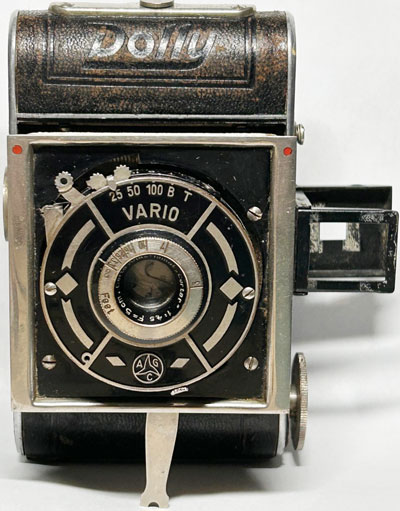
Art Deco Credentials ⓘ

Bold, geometric cameras from Deco’s golden age


Noteworthy: Distinct Deco elements worth attention
- Produced during the main Art Deco period.
- Geometric design on front face.
- Polished metal struts.
- Chrome used on lens standard.
- Repetative geometric embossed pattern in body covering;
- 'Dolly' embossed in front covering.
- Chromed camera stand.
- Bright metal used on tripod bush.
Specification
| Manufacturer | : | Certo |
|---|---|---|
| Produced | : | 1932 |
| Classification | : | Miniature |
| Body Type | : | Folding Strut |
| Bellows Deployment | : | Self Erecting |
| Construction | : | Metal |
| Film Type | : | 127 |
| Film Width | : | 46mm |
| Image Size | : | 1¼ x 1⅝ |
| No. of Images | : | 16 |
| Lens Type | : | Certo-Anastigmat |
| Focus Type | : | variable |
| Focal Length | : | 50mm |
| Focal Range | : | 3ft - inf. |
| Aperture Type | : | Iris |
| Apertures | : | f/4.5 - f/16 |
| Shutter Type | : | Variable |
| Shutter Speeds | : | B, T, I(1/25, 1/50, 1/100) |
| Size Open (w x h x d) | : | 110 x 94 x 65 mm |
| Size Closed (w x h x d) | : | 110 x 75 x 37 mm |
| Weight | : | 353g |
Description
The Certo Dolly camera is a strut folding camera for 3 x 4 cm pictures on 127 rollfilm. It takes 16 exposures on standard 8 exposure film. It is a metal body camera with leather covering and leather bellows. It has a simple pop-up view-finder. The bellows are self erecting. They are released when a button is pressed on the top of the body.
The shutter is a pivoted two-blade return type which is spring powered, giving speeds 1/25, 1/50, 1/100, B, T. The shutter release is above the lens behind the front plate. There is a connection for a cable release. This allows shake free images to be taken when the camera is on a tripod.
Apertures available are f/4.5 to f/16 that are selected by moving a lever under the lens. Focussing is achieved by turning the front lens and it can focus down to 3 feet.

Get a camera like this from Ebay - Certo Dolly 3x4
How to Use
This camera takes 127 film which is still available from select outlets - search for 'Rera Pan 100-127' which is a black & white film. For those photographers in the UK, try Nick & Trick photographic services. If you want to use a particular type of film which is not available commercially, then you can cut your own 127 film from any 120 film. See my page on 'How to cut 127 film from 120 film'. Don't forget to cover the red windows except when advancing the film in low light. Modern film is sensitive to red light.
The two red windows are used to get 16 exposures from 127 film. The film is advanced until a number appears in the first window and an image is taken. Then the film is advanced until the same number appears in the second window. Then it's back to the first window for the next number. Don't forget to cover the windows with black tape except when advancing the film in low light.
If you don't want to bother with an exposure meter, follow the guide shown, using shutter speeds are 1/25s, 1/50s and 1/100s only. It is based on the 'Sunny 16' rule. Film is so forgiving and will produce acceptable results even when overexposed by 2 or 3 stops or underexposed by 1 stop.
Remember that the exposure guide in the camera user manual may not be helpful as it is based on the use of old film with a low ISO value.
The tables assume that the sun is at least 30 degrees above the horizon - that's 10am - 5pm on a summer's day (May-August) in the UK.
If you are not sure about the light level, err on the side of overexposure - i.e. assume the smaller f number.
Where there is a choice, a larger f number will give a larger depth of field.
For the slower speeds, you may need a tripod to stop blur through shake.
Using ISO 100/125 film
| Weather Conditions | Shadow Detail | Shutter Speed (s) | ||
|---|---|---|---|---|
| 1/25 | 1/50 | 1/100 | ||
 Sunny Snow/Sand | Dark with sharp edges | - | - | - |
| Sunny | Distinct | - | - | f/16 |
 Slight Overcast | Soft around edges | - | f/16 | f/11 |
 Overcast | Barely visible | f/16 | f/11 | f/8 |
 Heavy Overcast | None | f/11 | f/8 | f/6.3 |
 Open Shade /Sunset | None | f/8 | f/6.3 | f/4.5 |
Get Film for this camera from Ebay - 127 film